Chapter 4 | Major and Minor Triads
In Lesson 3, you followed a pattern of steps to build a major scale. Now we will choose three notes from that scale and hear what happens when they sound together.
A chord shape puts your fingers in place. The notes inside it tell you what you are playing.
Three Notes Working Together
A triad is a chord built from three different notes: a root, a third and a fifth. In this chapter, we will work with the two types you already hear in countless songs: major and minor.
Count the different note names, not the number of strings you strum.
A guitar chord can use four, five or six strings and still be a triad. Some notes simply appear more than once, often in different octaves. More strings make the sound fuller without necessarily adding a new note name.
Start With the Major Scale
Write the G major scale and number its notes. These numbers describe each note’s position in the scale. They are not fret numbers or finger numbers.
| Position | 1 | 2 | 3 | 4 | 5 | 6 | 7 |
|---|---|---|---|---|---|---|---|
| G major | G | A | B | C | D | E | F# |
Choose positions 1, 3 and 5: G, B and D. Play those notes together and you have a G major triad.
One Chord, Different Shapes
The fingers move. The three note names stay the same.
Here are two ways to play G major. Read the note names beneath each string. Both shapes contain only G, B and D.
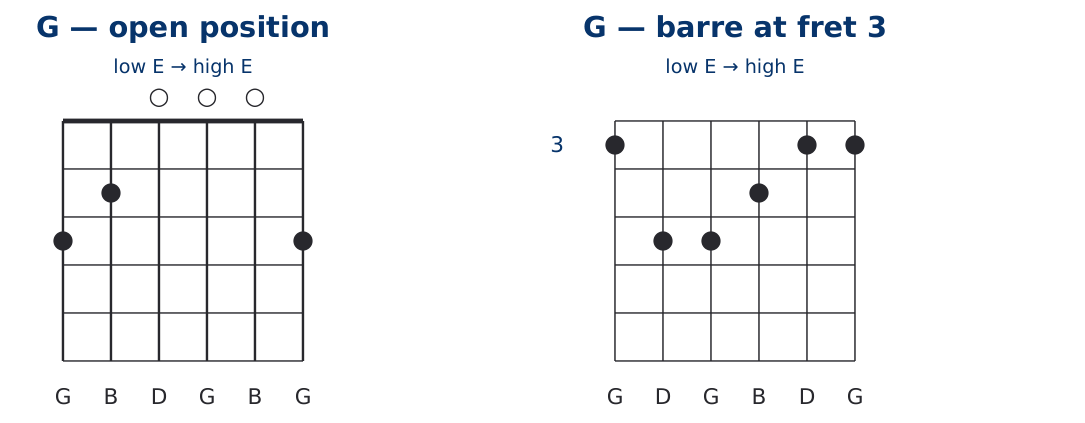
You do not need to master the barre chord today. It is here to show that a different shape can give you the same chord. Neither shape needs the notes to appear in scale order.
Listen to the Notes Inside
Play the open G chord one string at a time, from low E to high E. Say the note names: G, B, D, G, B, G. Then strum the whole chord.
You have played six strings, but only three different note names. The repeated Gs and Bs add weight and range to the sound.
The shape is a way to play the chord. The notes are what make it G major.
Reading Chord Names
A plain letter usually means a major chord: G means G major. A small m means minor: Gm means G minor. You may also see minor written out.
One Note Changes the Feel
To turn a major triad into a minor triad, lower its third by one semitone.
Keep the root and fifth where they are. Change only the third. On the same guitar string, lowering a note by one semitone means moving down one fret, toward the nut.
| Chord | Root (1) | Third | Fifth (5) |
|---|---|---|---|
| G major | G | B | D |
| G minor | G | Bb | D |
Both formulas use the major scale as their reference.
“Lowered” Does Not Always Mean a Flat Sign
The symbol b3 means a third lowered by one semitone from the major-scale third. Sometimes that produces a flat note, like B becoming Bb. Sometimes it produces a natural note, like G# becoming G.
In either case, the change is the same distance: one semitone.
Let Your Ears Do Some of the Work
Major is often described as happy and minor as sad. That can be a useful first impression, but a song’s feeling also comes from its rhythm, melody, tempo and the way it is played.
Listen for the change rather than trying to give every chord a fixed emotion. The important thing here is that moving one note changes the character of the whole chord.
Same root. Same fifth. A different third.
Hear It Under Your Fingers
Two familiar chord pairs make the one-semitone change easy to find.
Exercise 1 — E Major to E Minor
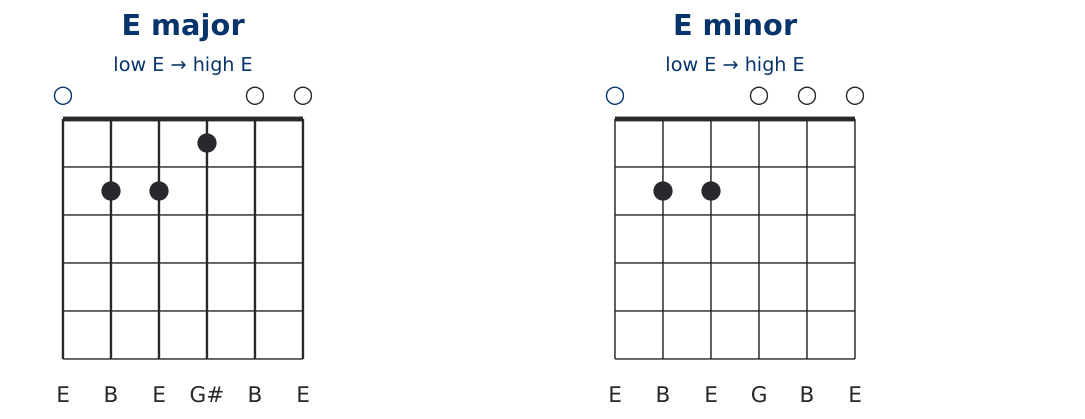
Play E major. Its third is G# at fret 1 on the G string. Lift that finger so the open G string sounds instead. You have lowered G# to G and made E minor. Alternate slowly between the chords and listen.
Exercise 2 — D Major to D Minor
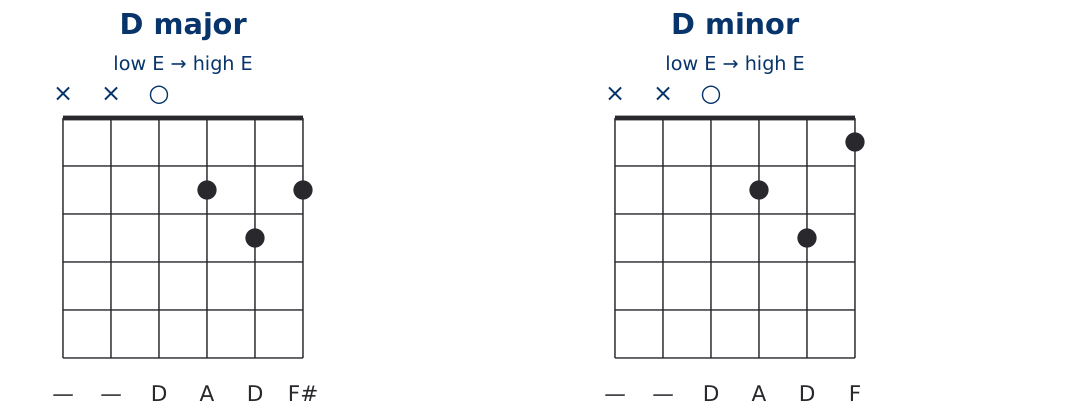
Strum only the top four strings. The third moves from F# at fret 2 on the high E string to F at fret 1. Your fingering may change, but the root and fifth stay the same.
Play the changing note on its own, then hear it inside the chord.
Build It. Then Listen.
The same method works from any starting pitch.
Try A Major and A Minor
The A major scale is A – B – C# – D – E – F# – G#. Choose the root, third and fifth: A, C# and E. Lower C# by one semitone and the minor triad becomes A, C and E.
If you know the open A and Am shapes, play them in turn. Find C# at fret 2 on the B string. In Am, that note becomes C at fret 1. Strum from the A string; leave the low E string out.
What About Power Chords?
A power chord, often written with a 5, uses the root and fifth. E5 contains E and B. You can add another E in a higher octave, but you still have only two different note names.
A power chord has no third, so it does not identify itself as major or minor. It is not a triad.
Try E5 using the open low E string and fret 2 on the A string. Play only those two strings. Compare it with E major and E minor. Notice what returns when you add the third.
A power chord can work in a major or minor setting, but replacing a full chord with one removes some of its colour. Let the song and your ears guide the choice.
A Little Further Down the Road
A triad is in root position when its root is the lowest note. If the third or fifth is lowest, it is an inversion. The same three note names remain, but the bass note changes how they sit together.
Diminished and augmented triads are two other types. Chords such as Gmaj7 and Gm7 add another different note to a triad. We will leave those sounds for later.
For now, be able to build a major triad, lower its third, and hear the difference.
Check Your Understanding
Write first. Play what you can. Look at the answers afterward.
- A triad contains how many different note names?
- Write the major-triad formula.
- Write the minor-triad formula.
- Which note changes when a major triad becomes minor?
- By how many semitones does that note move?
- Why can a six-string G chord still be a triad?
Choose the Notes
Use the major scale to find 1, 3 and 5. Then lower the third to make the minor triad.
| Starting Scale | Major Triad | Minor Triad |
|---|---|---|
| D E F# G A B C# | ________ | ________ |
| Bb C D Eb F G A | ________ | ________ |
- Does b3 always mean the resulting note has a flat sign? Give an example.
- Which two notes are in E5?
- Is a power chord a triad? Major or minor?
Check Your Answers
- Three different note names. Repeated notes do not add new ones.
- 1 + 3 + 5. Root, third and fifth from the major scale.
- 1 + b3 + 5. Use the same root and fifth, and lower the major-scale third by one semitone.
- The third.
- One semitone down. On the same string, that is one fret lower.
- It repeats G, B and D across the strings. There are six sounding strings, but only three different note names.
Choose the Notes — Answers
| Chord Pair | Major Triad | Minor Triad |
|---|---|---|
| D / Dm | D – F# – A | D – F – A |
| Bb / Bbm | Bb – D – F | Bb – Db – F |
- No. In E major, the third is G#. Lowering it makes G natural, the minor third.
- E and B. The root and fifth.
- No. A power chord has only two different note names and no third, so it is neither major nor minor on its own.
On the Guitar
Choose E/Em, D/Dm or A/Am. Play the pair and identify the string, frets and note names where the third changes.
Chord pair: __________________
String: __________________
Frets: __________________
Major third: __________________
Minor third: __________________
Check Your Guitar Exercise
E / Em: G string, fret 1 to open, G# to G.
D / Dm: High E string, fret 2 to fret 1, F# to F.
A / Am: B string, fret 2 to fret 1, C# to C.
What to Remember
The root names the chord; the third makes it major or minor. Connect the formula to the notes, the shape and the sound.
Next: intervals — names for the distances between notes.