Chapter 2 | Tones and Semitones
Music moves in steps. On the guitar, those steps are right under your fingers.
The Short Version
A semitone is the distance of one fret. A tone is the distance of two frets.
That is the whole idea. Tones and semitones are simply ways of measuring the distance between notes. You will use them constantly when you build scales, move chord shapes and work out melodies.
One Fret: A Semitone
Play any note, then move it up one fret on the same string. You have moved up a semitone.
For example, moving from the 2nd fret to the 3rd fret is one semitone.
Two Frets: A Tone
Move two frets on the same string and you have moved a tone.
Moving from the 7th fret down to the 5th fret is one tone.
Two Names for the Same Steps
You will also hear musicians use the terms half step and whole step.
A half step is a semitone. A whole step is a tone. Different words, same musical distance.
Do not turn this into a math problem. Listen to the change, feel the distance under your hand, and connect the sound to the name.
See It on the Guitar
One fret. Two frets. That’s it.
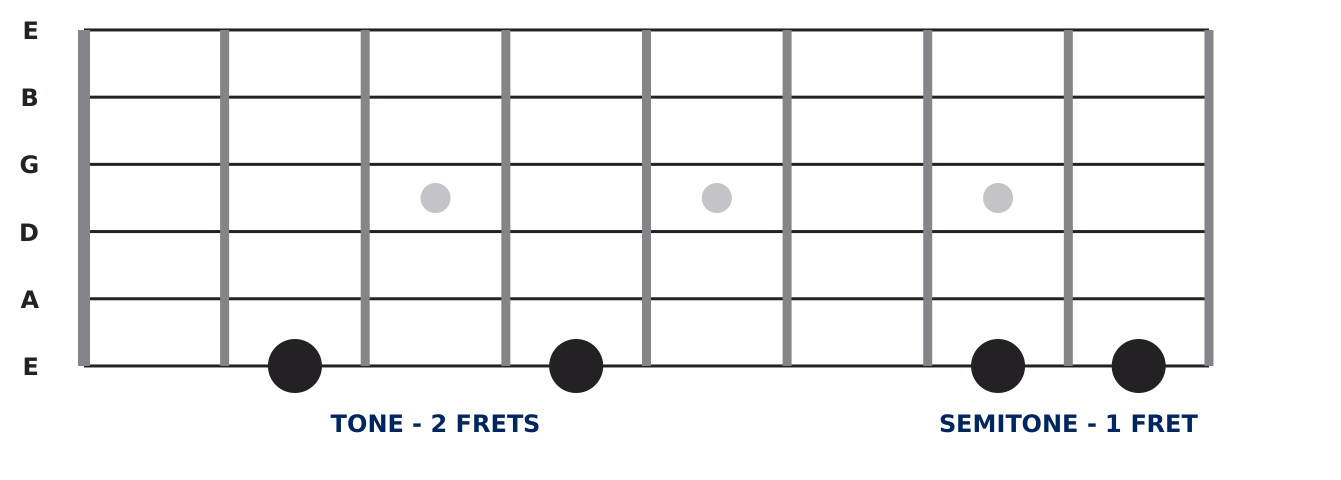
The black dots sit on the low E string. The pair on the left are two frets apart: a tone. The pair on the right are one fret apart: a semitone.
Try It
Choose any note on any string. Play it, move up one fret and listen.
Return to the first note, move up two frets and listen again.
The point is not just to memorize the definitions. It is to hear and feel the size of each step.
Quick Check
- A semitone is a distance of __________ fret.
- A tone is a distance of __________ frets.
- A semitone can also be called a ____________________.
- A tone can also be called a ____________________.
Check Your Answers
- A semitone is a distance of 1 fret.
- A tone is a distance of 2 frets.
- A semitone can also be called a half step.
- A tone can also be called a whole step.
What to Remember
You do not need a longer definition. If you can see one fret and two frets on the neck—and hear the difference—you understand tones and semitones.
In the next chapter, we will use these two building blocks to understand how a major scale is put together.