Chapter 1 | The Musical Alphabet
Every song, chord, riff and melody is built from 12 notes. Let’s get to know their names.
By the end of this lesson: you’ll know the seven natural notes, understand sharps and flats, and play the complete 12-note pattern on one guitar string.
Start with seven natural notes
The musical alphabet begins with seven letters:
A · B · C · D · E · F · G
These are the natural notes. After G, the letters begin again at A. Keep moving upward and the next A sounds higher, even though its name is the same.
But seven letters don’t account for every pitch. Five more notes sit between some of the natural notes, giving us 12 pitches in the complete pattern. Playing them in order is called the chromatic scale.
The notes between: sharps and flats
A sharp (♯) raises a note by one semitone. A flat (♭) lowers it by one semitone. On the guitar, a semitone is the distance of one fret. In plain text, you’ll often see these written as # and b.
The note between C and D can be called C♯ or D♭: one fret above C, or one fret below D.
On a normally tuned guitar, those two names point to the same pitch. The musical context determines which name we use. For now, learn to recognize both.
The complete pattern, starting on A:
A · A♯/B♭ · B · C · C♯/D♭ · D · D♯/E♭ · E · F · F♯/G♭ · G · G♯/A♭ · A
That last A is the start of the next cycle. It repeats the first note name; it isn’t a thirteenth pitch in the pattern.
See it on a keyboard
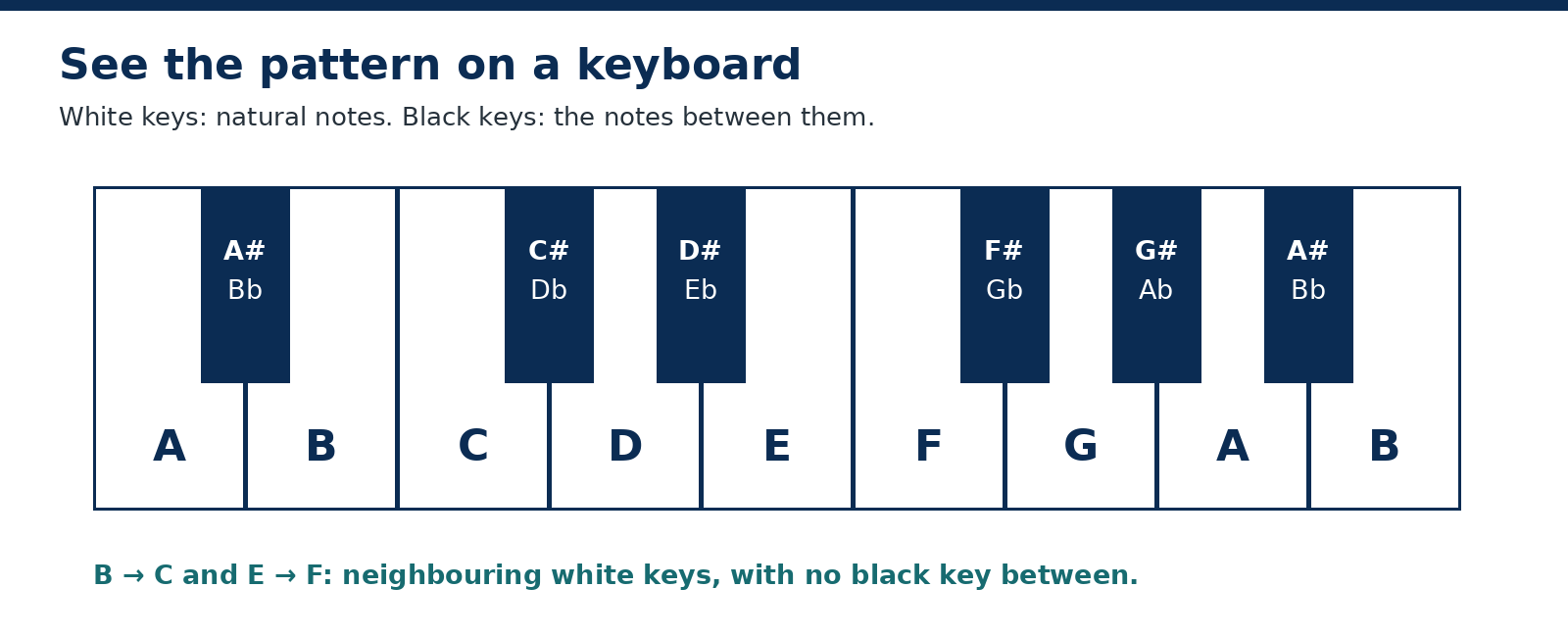
The white keys show the natural notes. The black keys show the notes between them. You don’t need to play piano—the keyboard simply makes the pattern easy to see.
Notice the two neighbouring pairs
B → C and E → F have no extra pitch between them. On the guitar, each pair is just one fret apart.
For this lesson, remember those two places in the pattern. Names such as B♯ and C♭ do exist in other musical contexts, but they don’t create additional pitches between B and C.
Put it on the guitar
Move up one fret and you move to the next pitch in the musical alphabet. The guitar lets you hear and see the pattern in a straight line.
Exercise 1: Start on A
- Find A at the 5th fret of the low E string—the thickest string.
- Play fret 6: A♯/B♭. Then fret 7: B.
- Continue upward, one fret at a time. Say each note name aloud.
- Stop at fret 17. You’ve reached A again, one octave higher.

Go slowly enough to connect three things: the note name, its fret position, and the sound. This is about understanding the pattern, not playing it fast.
Exercise 2: Start on C
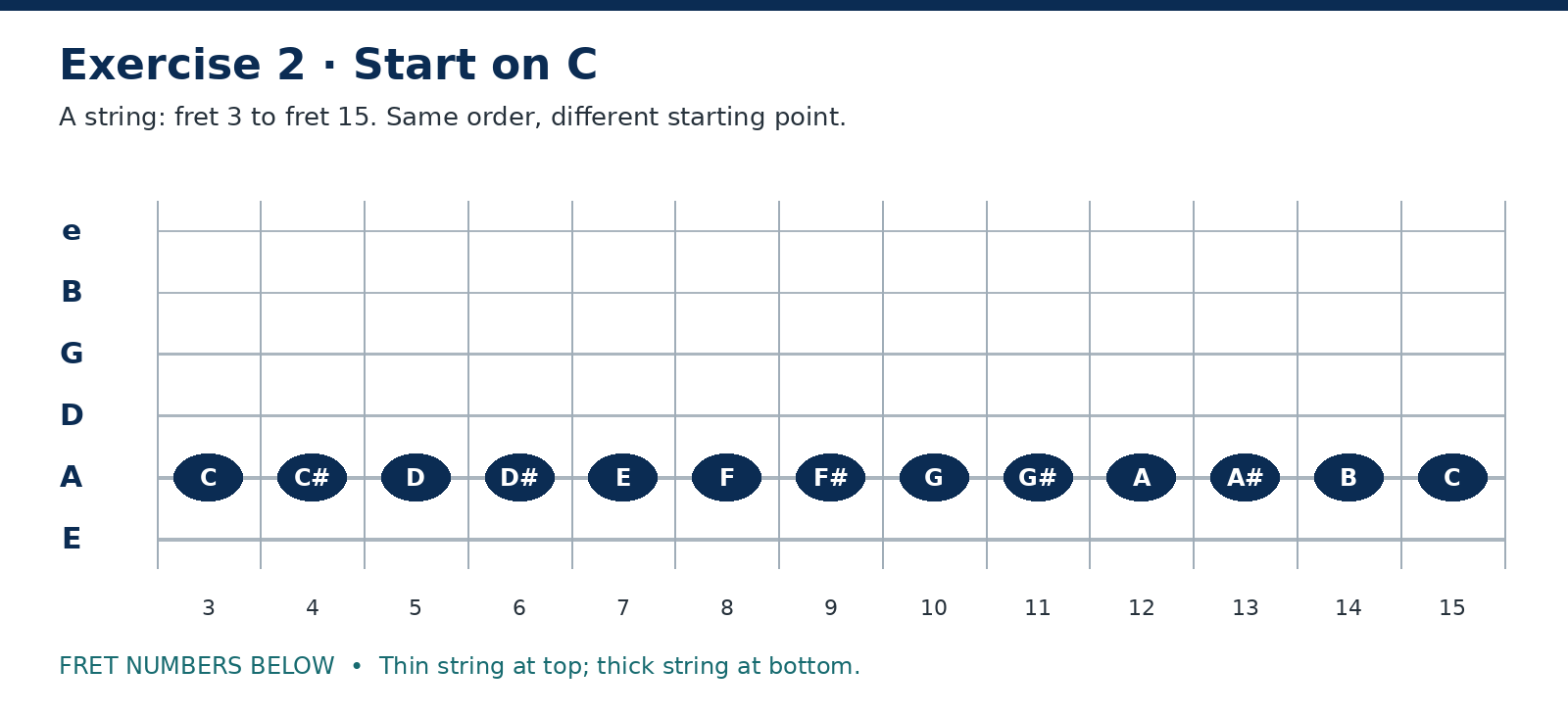
The order never changes. You can enter the pattern anywhere.
- Find C at the 3rd fret of the A string.
- Play fret 4: C♯/D♭. Then fret 5: D.
- Continue one fret at a time, saying the names aloud.
- Stop at fret 15. You’ve reached C again, one octave higher.
One alphabet, six starting points
In standard tuning, the open strings are E–A–D–G–B–E, from thickest to thinnest. Each string starts at a different point in the same 12-note cycle.

You don’t need to memorize the whole neck today. First understand the pattern. Fretboard knowledge grows much faster once the pattern makes sense.
Try it without looking back
Write your answers on paper, then pick up the guitar and check what you wrote.
- How many pitches are in the complete musical alphabet?
- What is the complete sequence also called?
- What do we call the notes A, B, C, D, E, F and G?
- Which symbol means sharp?
- Which symbol means flat?
- Which two pairs of natural notes are only one fret apart?
- The note between G and A has two names. What are they?
- The note between D and E has two names. What are they?
Complete the pattern
Start on C and write every pitch in order until you reach the next C. Use sharp names, flat names, or both.
Then play your sequence from the 3rd fret of the A string.
Listen as you check: did you put an extra note between B and C, or between E and F? Can you keep going without restarting the alphabet?
Check your answers
- 12 pitches.
- The chromatic scale.
- Natural notes.
- ♯ (or # in plain text).
- ♭ (or b in plain text).
- B–C and E–F.
- G♯ or A♭.
- D♯ or E♭.
Completed pattern:
C · C♯/D♭ · D · D♯/E♭ · E · F · F♯/G♭ · G · G♯/A♭ · A · A♯/B♭ · B · C
What to take with you
Seven natural notes. Five notes between them. Twelve pitches in a repeating pattern.
Learn the order, remember B–C and E–F, and connect the names to the fretboard. Everything we build from here starts with that.
Next lesson: tones and semitones—the distances between notes.