Chapter 5 | Intervals: Naming the Distance
A note tells you where you are. An interval tells you how far you have moved.
You already know two intervals: the tone and the semitone. Now we will give names to larger distances. These names help musicians describe melodies and understand the notes inside chords.
Give a Distance a Name
An interval is the distance between two notes. For this lesson, measure upward from C to each note in the C major scale. C is our reference, so number it 1 and count from there.
| Note | C | D | E | F | G | A | B | C |
|---|---|---|---|---|---|---|---|---|
| Number | 1 | 2 | 3 | 4 | 5 | 6 | 7 | 8 |
C to E is a third. C to G is a fifth. The C above your starting C is an octave. We count both the starting letter and the ending letter: C–D–E spans three letter names.
Interval numbers count the letter-name span. They are not the number of frets between the notes.
Give the Interval Its Full Name
The intervals from the root of a major scale are major seconds, thirds, sixths and sevenths, and perfect fourths and fifths. A same-pitch repeat is a perfect unison; a repeat 12 semitones higher is a perfect octave.
“Major” and “perfect” describe interval quality. They do not tell you whether the interval is good or impressive. In the next chapter, these words will help us distinguish distances with the same number.
See It. Hear It. Name It.
Use one string first, so the distance stays easy to see.
C Major — A String

| From C to… | Interval | Semitones |
|---|---|---|
| C (same pitch) | Perfect unison | 0 |
| D | Major second | 2 |
| E | Major third | 4 |
| F | Perfect fourth | 5 |
| G | Perfect fifth | 7 |
| A | Major sixth | 9 |
| B | Major seventh | 11 |
| C (higher) | Perfect octave | 12 |
Keep Returning to C
Play C at fret 3, then E at fret 7. Return to C, then play G at fret 10. Say “major third” and “perfect fifth” as you hear the distances. Do the same with the other notes.
Next, sing or hum the higher note before you play it. You do not need perfect pitch. You are connecting the distance under your fingers to the distance in your ear.
Moving the starting note changes the pitches. It does not change the size of a major third or perfect fifth.
Across the Strings
The distance belongs to the sound, even when the fingering changes.
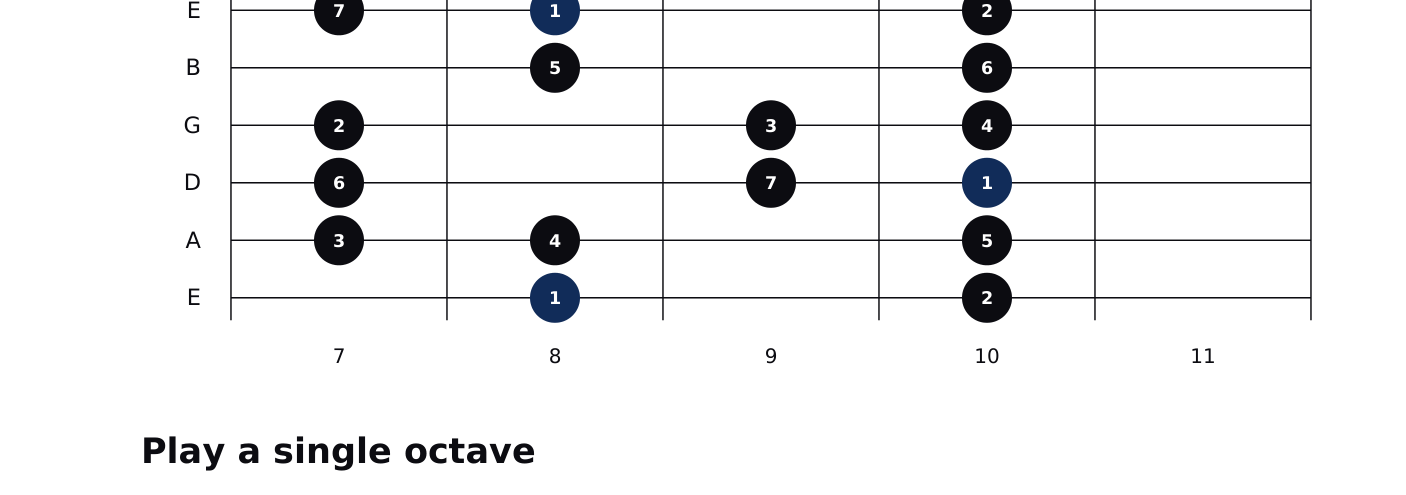
Here is C major in one area of the neck. The dots show interval numbers measured from C. Blue dots are roots. High E is at the top; low E is at the bottom. The numbers beneath the diagram are frets.
C Major — Frets 7–11
Play a Single Octave
Begin on C at fret 8 of the low E string. Play 8–10 on low E, 7–8–10 on A, then 7–9–10 on D. Stop on the higher C. That is one octave of C major.
Say “1, 2, 3, 4, 5, 6, 7, 1” while you play. The final 1 is the same scale degree in the next octave; it is also an octave above your first note.
Connect It to a Chord
Find 1, 3 and 5 in the pattern. Their note names are C, E and G: the C major triad.
Intervals give us a way to describe the chord without depending on a particular guitar shape.
An interval is a relationship between two notes. A scale degree is a note’s position within a scale. From the tonic, the numbers line up.
Check Your Understanding
Write the answers, then check them on the guitar.
- What does an interval measure?
- Why is C to E a third rather than a fourth?
- Use F major: F – G – A – Bb – C – D – E. Name the note at each position in the table below.
| Position | 2 | 3 | 4 | 5 | 6 | 7 |
|---|---|---|---|---|---|---|
| Note | ___ | ___ | ___ | ___ | ___ | ___ |
4. Give each ascending interval its full name.
| Notes | Interval |
|---|---|
| G to A | __________ |
| G to B | __________ |
| G to C | __________ |
| G to D | __________ |
| G to E | __________ |
| G to F# | __________ |
5. What is the interval from G to the same-pitch G? What about G to the G 12 semitones higher?
Guitar Check
On the A string, play C at fret 3. Write the fret for its major third and perfect fifth, then play them.
Third: __________ Fifth: __________
Check Your Answers
1. The distance between two notes.
2. C, D and E span three letter names, counting both ends. The major third covers four semitones, but its number is three.
3. F Major Positions
| Position | 2 | 3 | 4 | 5 | 6 | 7 |
|---|---|---|---|---|---|---|
| Note | G | A | Bb | C | D | E |
4. Ascending Intervals
| Notes | Interval |
|---|---|
| G to A | Major second |
| G to B | Major third |
| G to C | Perfect fourth |
| G to D | Perfect fifth |
| G to E | Major sixth |
| G to F# | Major seventh |
5. Same-pitch G to G: perfect unison. G to G 12 semitones higher: perfect octave.
Guitar Check
E at fret 7 is the major third above C. G at fret 10 is the perfect fifth.
What to Remember
Know the number, know the size, and listen to the distance. Those three things make intervals useful.
Next: changing interval quality by moving a note one semitone.